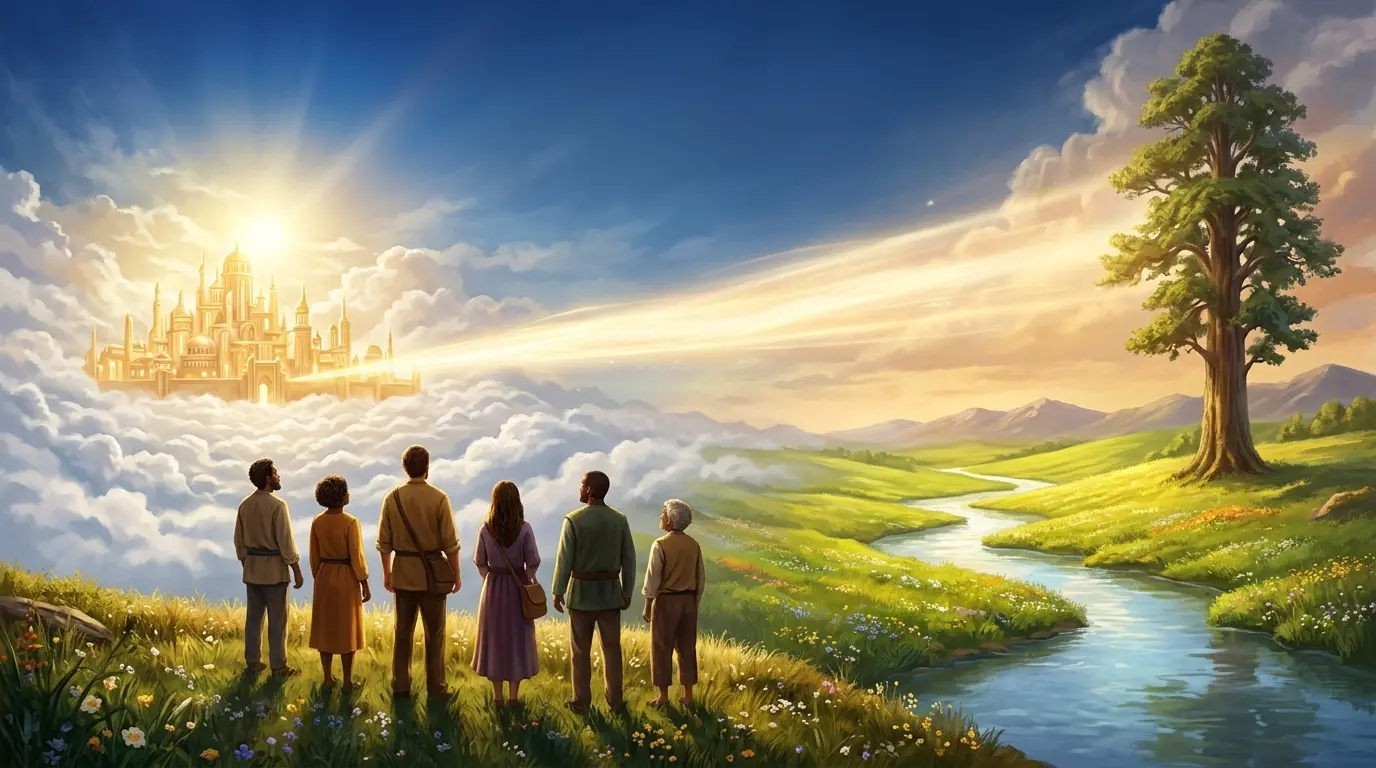
Ask ten people where the saved will spend eternity and you’ll get two loud answers. Most will say, “Heaven, obviously, in the clouds, with harps.” A Jehovah's witness will say, “Right here on earth, forever, just like Eden.” Each camp tends to look at the other with a raised eyebrow.
Here’s the twist: both camps are holding part of the picture, and both are missing a piece. The truth sits somewhere in the middle, and it is far more beautiful than either extreme. Let’s walk through it carefully, with the Bible open in front of us.
The Two Extremes
The Jehovah's witness view says the redeemed live on this earth forever, and that is it. The other, more popular, says the redeemed go straight to heaven at death and stay there forever. The irony is that many who criticize the Jehovah's witness view hold a second view that is even further from Scripture. The idea that a person goes to heaven the moment they die is one of the most widespread deceptions in Christianity. I’ve written about it separately, so rather than repeat myself, you can read that here.
For now, let’s focus on what the Bible says about the earth, because there’s a lot more there than most of us were taught.
What the Jehovah's Witnesses Get Right
They are not making it up. Jesus said it plainly:
Blessed are the meek: for they shall inherit the earth.
(Matthew 5:5, KJV)
David said the same thing centuries earlier:
But the meek shall inherit the earth; and shall delight themselves in the abundance of peace.
(Psalm 37:11, KJV)
And Isaiah tells us what the earth was made for:
For thus saith the LORD that created the heavens; God himself that formed the earth and made it; he hath established it, he created it not in vain, he formed it to be inhabited: I am the LORD; and there is none else.
(Isaiah 45:18, KJV)
God made the earth to be lived on. When He finished creation, He looked at it and said:
And God saw every thing that he had made, and, behold, it was very good.
(Genesis 1:31, KJV)
So yes, God’s original plan was humanity living on a perfect earth, in His presence, with no sin. Sin interrupted the plan. It did not cancel it. Fact number one: God will restore humanity to the earth, as He intended before sin.

But Which Earth?
Here’s where the Jehovah's witness view needs a small correction. Does the Bible say we will inherit this earth, as it is right now, scarred by wars, pollution, and bad traffic? Not quite. Look at what Peter writes:
But the day of the Lord will come as a thief in the night; in the which the heavens shall pass away with a great noise, and the elements shall melt with fervent heat, the earth also and the works that are therein shall be burned up.
(2 Peter 3:10, KJV)
That is a heavy verse. The present earth does not make it to the finish line. Fact number two: God will destroy the earth with fire to put an end to sin and sinners.
The prophet Malachi describes the same event:
For, behold, the day cometh, that shall burn as an oven; and all the proud, yea, and all that do wickedly, shall be stubble: and the day that cometh shall burn them up, saith the LORD of hosts, that it shall leave them neither root nor branch.
(Malachi 4:1, KJV)
And in the very next breath, Peter gives us the hope:
Nevertheless we, according to his promise, look for new heavens and a new earth, wherein dwelleth righteousness.
(2 Peter 3:13, KJV)
John saw it too:
And I saw a new heaven and a new earth: for the first heaven and the first earth were passed away; and there was no more sea.
(Revelation 21:1, KJV)
Fact number three: a new earth is presented in Revelation.
Put the three facts side by side and the conclusion is hard to avoid. The earth that the meek will inherit is the new earth, not the old one patched up. The old earth is destroyed, along with sin, unrepentant sinners, demons, and the devil himself. Then God recreates it. Think of it less as a renovation and more as a fresh start, with the original blueprint restored.
So Where Is Hell?
This is the part that surprises people. Many of us grew up picturing hell as a place that already exists somewhere, with flames going right now. The Bible doesn’t describe it that way. There is no burning hell operating at this very moment, and no purgatory either. Scripture teaches that the dead are waiting in the grave, not in a fiery chamber:
For the living know that they shall die: but the dead know not any thing, neither have they any more a reward; for the memory of them is forgotten.
(Ecclesiastes 9:5, KJV)
So when does the fire come? At the end. Revelation shows the wicked surrounding the camp of the saints after the thousand years, and then:
And they went up on the breadth of the earth, and compassed the camp of the saints about, and the beloved city: and fire came down from God out of heaven, and devoured them.
(Revelation 20:9, KJV)
Malachi adds the aftermath:
And ye shall tread down the wicked; for they shall be ashes under the soles of your feet in the day that I shall do this, saith the LORD of hosts.
(Malachi 4:3, KJV)
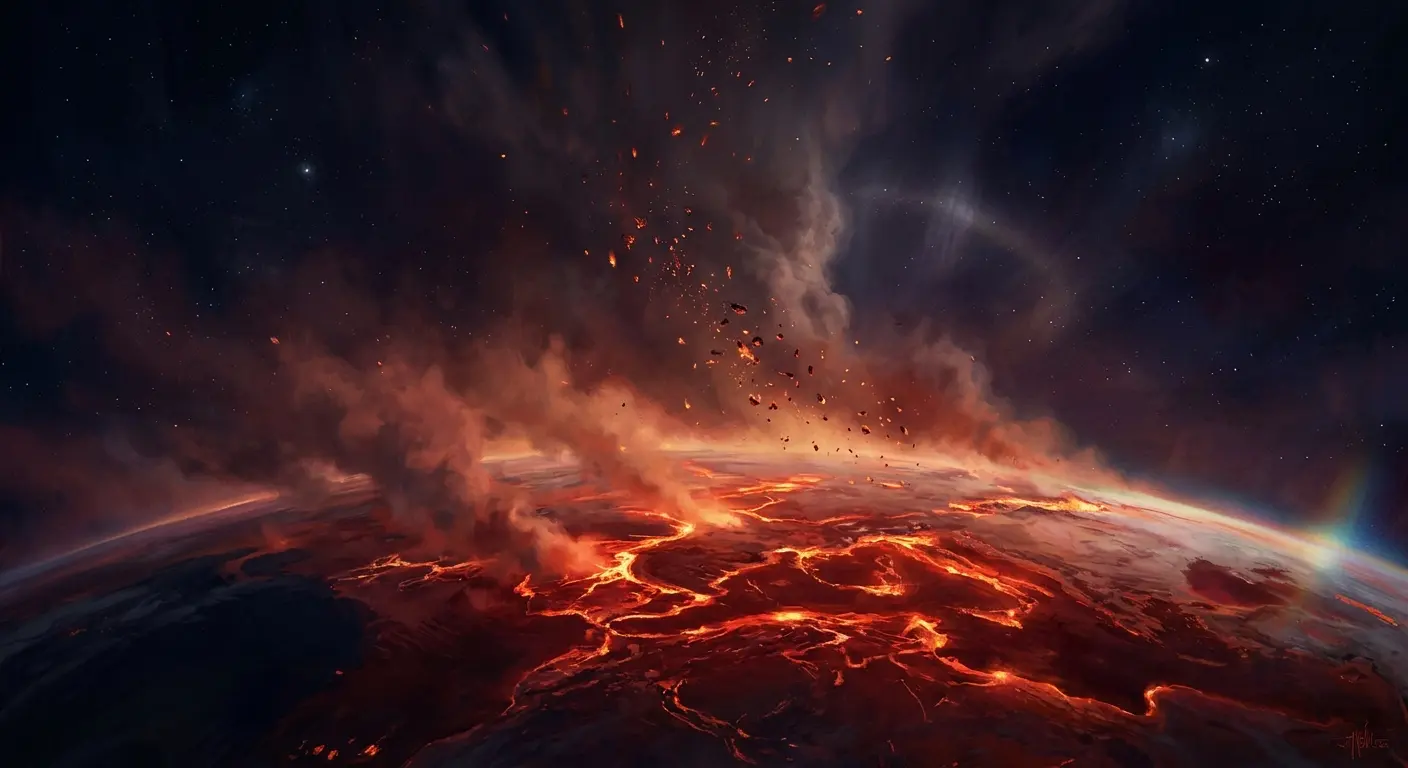
In other words, hell is not a basement location. Hell is what this earth becomes when God burns away sin, unrepentant sinners, demons, and the devil. It is real, it is final, and it is not eternal torment. It is an end. Then, in the words of the prophet:
What do ye imagine against the LORD? he will make an utter end: affliction shall not rise up the second time.
(Nahum 1:9, KJV)
Sin does not get a sequel.
The Timeline: When Do We Go to Heaven?
Here is the question that trips people up. If the saved will live on the earth forever, when do they go to heaven? Or do they not go at all?
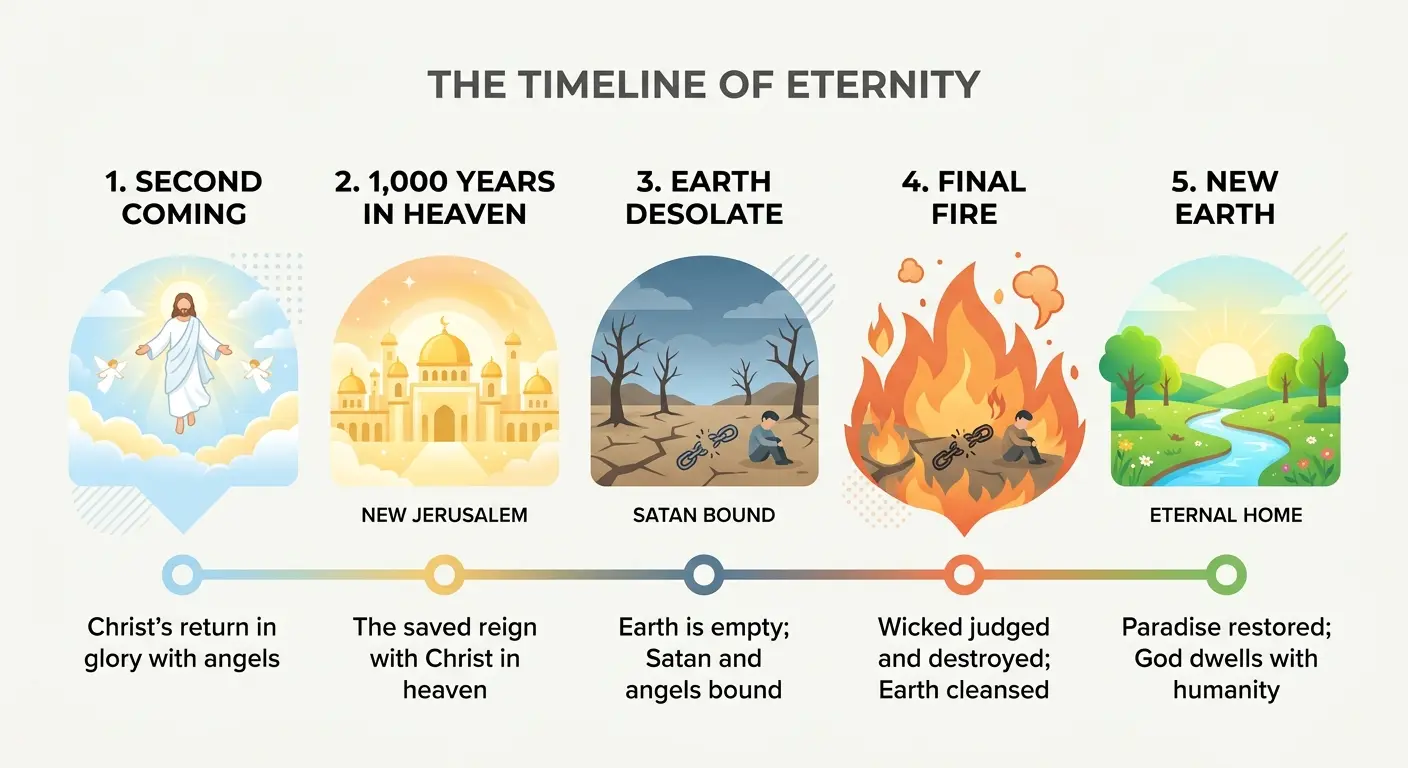
They do go. Just not at death, and not forever. Here is the order of events, as the Bible lays it out.
Step 1: Jesus returns. Paul describes the scene:
For the Lord himself shall descend from heaven with a shout, with the voice of the archangel, and with the trump of God: and the dead in Christ shall rise first: Then we which are alive and remain shall be caught up together with them in the clouds, to meet the Lord in the air: and so shall we ever be with the Lord.
(1 Thessalonians 4:16-17, KJV)
The righteous dead are raised, the righteous living are changed, and together they meet Jesus in the air. And where does He take them? He told His disciples:
And if I go and prepare a place for you, I will come again, and receive you unto myself; that where I am, there ye may be also.
(John 14:3, KJV)
That place is in the Father’s house, in heaven.
Step 2: A thousand years in heaven. John writes:
And I saw thrones, and they sat upon them, and judgment was given unto them: … and they lived and reigned with Christ a thousand years.
(Revelation 20:4, KJV)
There is no indication in the text that this number is symbolic, so we understand it as a literal thousand years. During that time the redeemed are with Christ, and judgment is given to them. Paul asks, “Do ye not know that the saints shall judge the world?” (1 Corinthians 6:2, KJV). It’s a time for the saved to see, with their own eyes, how God handled every case, so that every question about His fairness is answered.
Meanwhile, the earth is empty. The wicked dead stay in their graves:
But the rest of the dead lived not again until the thousand years were finished.
(Revelation 20:5, KJV)
Step 3: The devil is bound on a desolate earth. John continues:
And I saw an angel come down from heaven, having the key of the bottomless pit and a great chain in his hand. And he laid hold on the dragon, that old serpent, which is the Devil, and Satan, and bound him a thousand years.
(Revelation 20:1-2, KJV)
This isn’t a chain you could buy at a hardware store. The “chain” is the circumstance: no one left to tempt, no one to deceive, a ruined earth, and a long time to think about it.
Step 4: The final judgment and the fire. After the thousand years, the holy city descends, the wicked are raised, and fire from God devours the earth and everything wicked on it, as we saw in Revelation 20:9.
Step 5: The new earth. And then, at last:
And I saw a new heaven and a new earth… And I John saw the holy city, new Jerusalem, coming down from God out of heaven, prepared as a bride adorned for her husband. And I heard a great voice out of heaven saying, Behold, the tabernacle of God is with men, and he will dwell with them.
(Revelation 21:1-3, KJV)
God comes down to live with His people on the new earth. And look at what follows:
And God shall wipe away all tears from their eyes; and there shall be no more death, neither sorrow, nor crying, neither shall there be any more pain: for the former things are passed away.
(Revelation 21:4, KJV)
That is the middle ground. Not heaven forever. Not this earth forever. Heaven for a thousand years, then a new earth for eternity.
The Sanctuary Makes It Clearer
Things click into place when we look at the earthly sanctuary that God had Israel build. It was a living picture of the plan of salvation, and the Day of Atonement is the key piece for this timeline.
On that day, the high priest went into the most holy place to make atonement for the people. Hebrews explains that this earthly service was a copy of the real one in heaven. In the sanctuary, it was a day of judgment: those who afflicted their souls were cleansed, and those who didn’t were cut off from the people (Leviticus 23:27-30). The same idea appears in heaven’s judgment, which is rightly called the investigative judgment: a review of the records of our lives, which the angels have been keeping accurately from the day we are born. Solomon wrote:
For God shall bring every work into judgment, with every secret thing, whether it be good or evil.
(Ecclesiastes 12:14, KJV)
The timing is anchored in Daniel’s prophecy, which can be traced to 1844:
And he said unto me, Unto two thousand and three hundred days; then shall the sanctuary be cleansed.
(Daniel 8:14, KJV)
And Revelation announces that this time has arrived:
Saying with a loud voice, Fear God, and give glory to him; for the hour of his judgment is come.
(Revelation 14:7, KJV)
Here’s a detail that clears up a lot of confusion: you are not present when your case is presented. Cases are decided, either for salvation or for destruction, before anyone goes anywhere. Nobody gets to heaven, sits in the courtroom, and finds out they were not supposed to be there. The investigative judgment is finished by the time Jesus returns. In fact, Jesus comes because it is finished, just as the high priest came out of the sanctuary after making atonement to bless the waiting congregation. His own words:
And, behold, I come quickly; and my reward is with me, to give every man according as his work shall be.
(Revelation 22:12, KJV)
The reward is already decided when He arrives. This is happening now, while the angels keep recording everything we do and say, publicly or secretly. That should be sobering, and also comforting, because our Advocate is the one standing in the judgment on our behalf.
What About the Scapegoat?
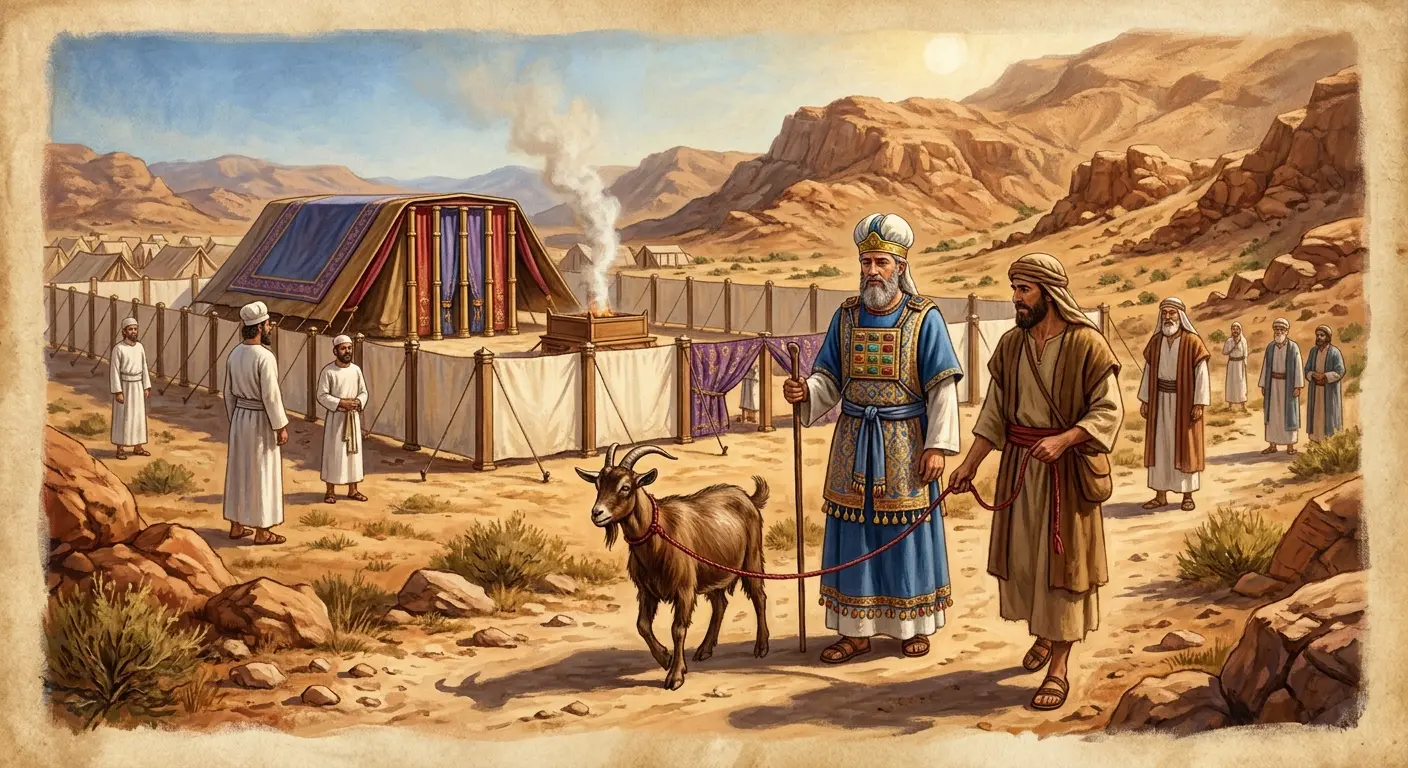
The Day of Atonement had another piece that is easy to misunderstand. Two goats were used. One was sacrificed, representing Jesus, whose blood cleanses our sins. The other, the scapegoat, was handled very differently:
And Aaron shall lay both his hands upon the head of the live goat, and confess over him all the iniquities of the children of Israel, and all their transgressions in all their sins, putting them upon the head of the goat, and shall send him away by the hand of a fit man into the wilderness.
(Leviticus 16:21, KJV)
The scapegoat did not atone for anything. The atonement was already made by the first goat. The sins, already forgiven and removed by blood, were placed on the one responsible for them, and he was sent away to a desolate land, where he died alone.
The scapegoat represents Satan. He is not our Savior; he is the originator of sin and the one who leads people into it. He ultimately bears the penalty for the sins he caused God’s people to commit, sins that have already been washed away by Jesus’ blood on the cross. The wilderness is the earth during the thousand years, the desolate place where the devil is bound (Revelation 20:1-3), and the fire at the end finishes the picture.
The symbolism fits together beautifully: Jesus pays for our sins, the sins are carried out of the sanctuary, and the one who tempted us faces the consequences. Justice and mercy, side by side.
Why This Matters
It’s easy to treat all of this as a puzzle for Bible nerds. It is much more than that. The picture we hold of the future shapes how we think about God’s character.
If hell were a place of endless torture, God would look cruel. If the dead were already in heaven, the resurrection would be redundant. If heaven were forever, we would lose the promise of a restored earth. When the pieces are placed in order, God looks like what He is: just, merciful, and committed to finishing what He started in Eden. He ends sin completely, and then He gives His people the world He always intended for them.
Paul sums up the hope in a way that settles every question in just a few words: “and so shall we ever be with the Lord” (1 Thessalonians 4:17, KJV).
That’s the destination. Whether it’s a cloud or a continent matters less than the One who is with us there.
Final Thoughts
So here is where we land. The meek really will inherit the earth, but it will be a new earth, not this one. The wicked will meet a final fire, not an endless one. The saved will go to heaven, but for a thousand years, not forever. And then God will make all things new, and sin will never rise again.
If you grew up with the “heaven forever” or “this earth forever” version, don’t be discouraged. The Bible’s plan is bigger than both. Open your Bible, test everything I’ve said against it, and ask God for understanding. He loves that kind of question.
Don’t forget to check out my post on what happens when we die.